DeCare was our six-person Bangkit Academy capstone in 2021: an Android app for home caregivers that paired guided cognitive screening with a cloud prediction and daily care tools. I focused on app design and Android implementation while teammates built the model and cloud services. The full presentation below shows the problem and product.
From answers to a result
1. Eleven MMSE prompts
The person being screened worked through eleven Mini-Mental State Examination (MMSE) prompts in DeCare while a caregiver stayed beside them. The app guided the sequence on the phone; the caregiver helped with the process and later reviewed answers that needed human judgment.
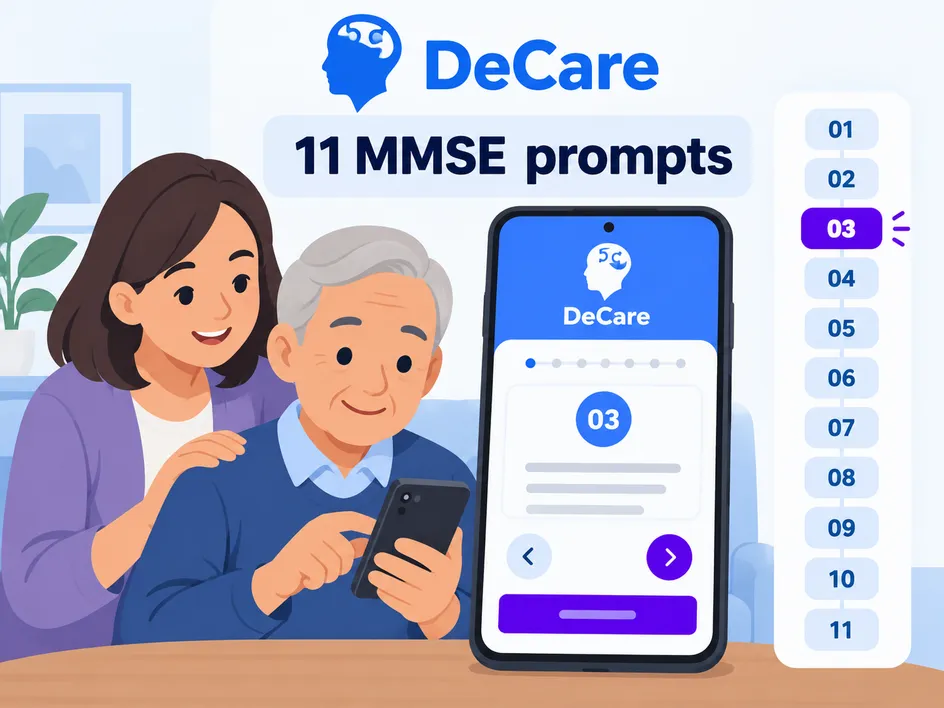
Illustration based on DeCare’s original Android interface. View full size.
2. Six app-scored, five caregiver-scored
The Android app scored six responses automatically. The caregiver reviewed and scored the other five. After both parts were complete, the app added all eleven item scores into the MMSE total.
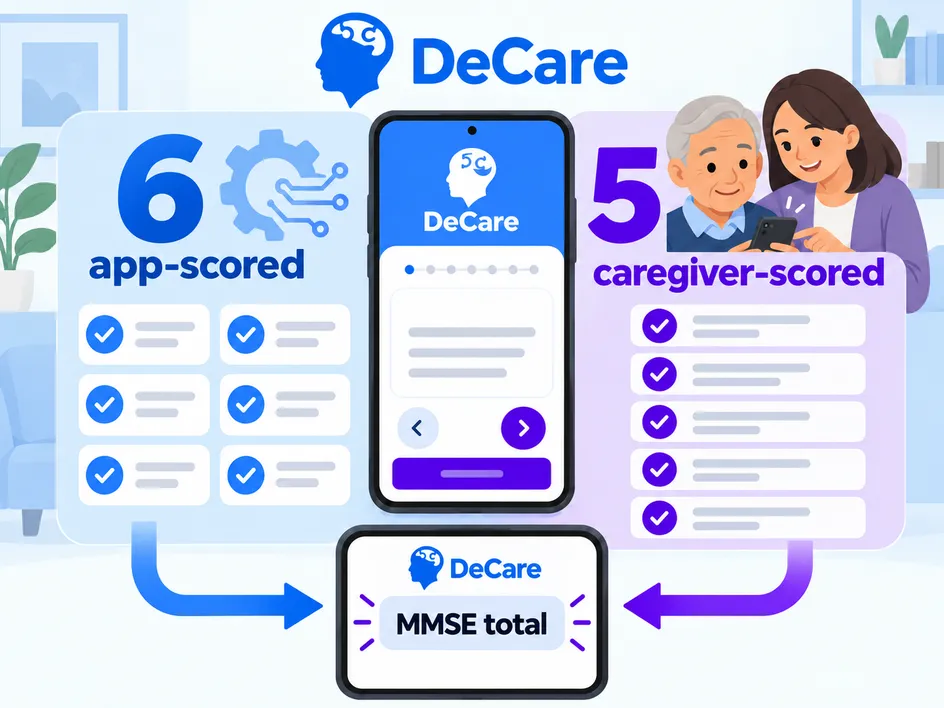
Two scoring paths become one total on the phone. View full size.
3. The phone sends a score and profile to the cloud
The app reconciled the eleven item scores into one MMSE total and showed it on the phone. When someone selected Predict, it paired that total with the patient’s age, education, socioeconomic status, and sex and sent those values to the team’s cloud endpoint. The cloud model processed them to produce a prediction.
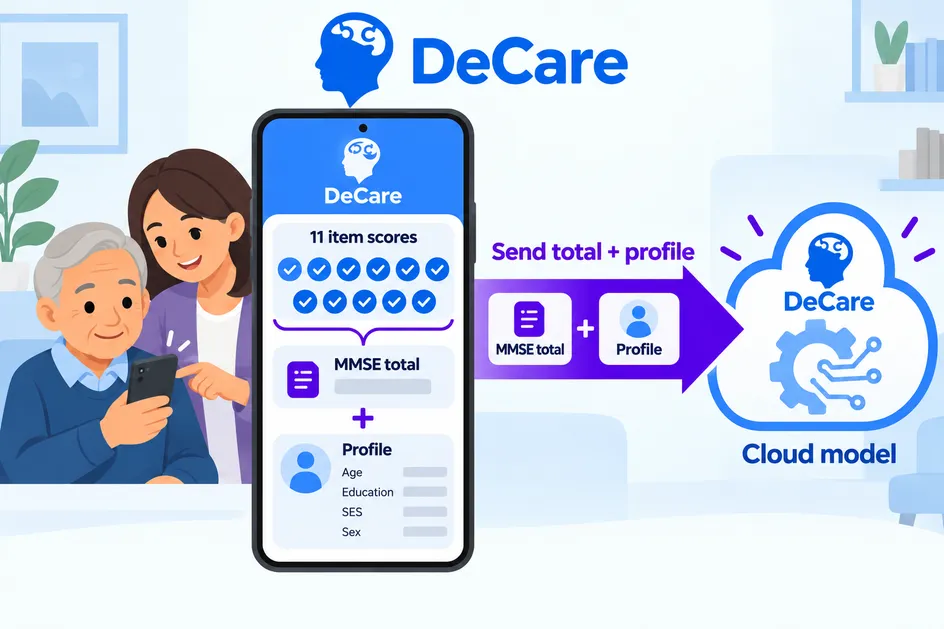
Phone total and profile sent to the cloud. View full size.
4. The prediction returns to the phone
The cloud model returned a prediction label and confidence value. DeCare added them to the result screen alongside the MMSE total. If the request failed, the score remained visible and the app reported the error.
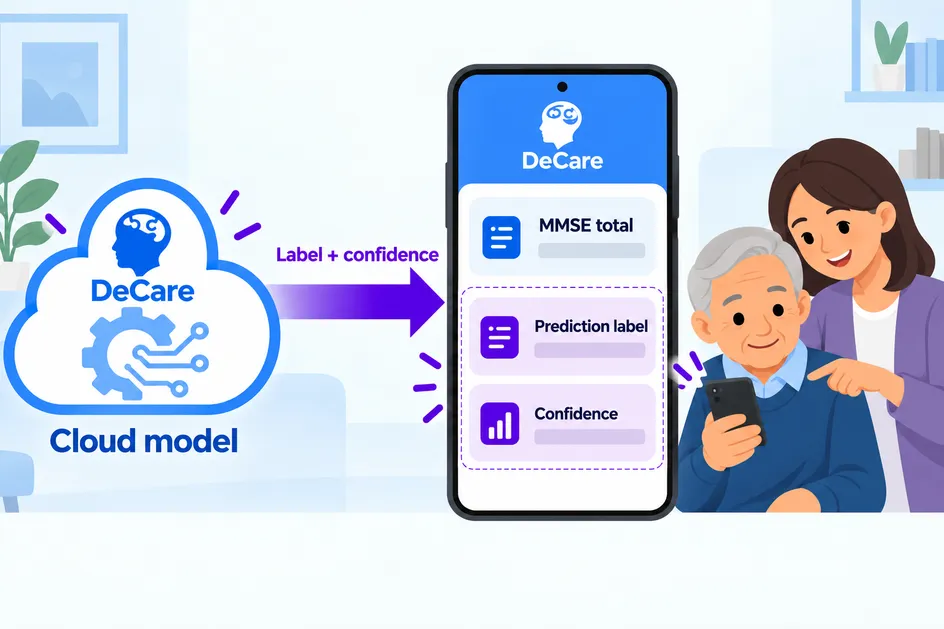
Cloud response beside the MMSE total. View full size.
The same app also supported everyday care through activity reminders, guided yoga, and health articles. The Android source, model experiments, and Flask backend show the separate parts of the system.
Outcome and limits
The team completed the capstone and published the Android app on Google Play in 2021. That is the delivery outcome I can substantiate. I do not have evidence here that DeCare improved patient outcomes or that its model was clinically validated. The displayed model result is a prediction, not a diagnosis; cognitive screening alone is insufficient to diagnose dementia.
For me, DeCare was an exercise in making a multi-step, two-person process work on a phone while connecting it to a larger team-built system. The clearest evidence of my contribution is the Android experience itself: instructions, screening, caregiver review, result, and the daily tools around it.